
Search Results
Your search for May returned 4 categories and 55 items
Items
About Us > Our Mission Statement
Disclaimer
None of the information provided in this website, or any of it's linking pages, is intended for the purpose of diagnosis, prescription or suggested treatment of any kind. Visitors to our website are presumed to have consulted with their own veterinarian about the information we present as it pertains to, and is complementary with, the overall health and well-being of their animals.
We also remind and warn visitors of the inherent risks associated with animal activities. We do not assume any liability or responsibility for damages suffered by, an injury to, or the death of, a participant in animal activities resulting from the inherent risks of animal activities.
About Us > Research & Studies
Cattle 2012 Reducing Avoidance and Stress
Gentle touching in early life reduces avoidance distance and slaughter stress in beef cattle
by Johanna Probst, Anet Spengler Neffa, Florian Leiberb, Michael Kreuzerb, Edna Hillmannb of Switzerland
Abstract
This study investigated the effect of gentle touching applied during the early life of suckler beef calves on avoidance distance on-farm and stress reactions at the abattoir. Twenty-seven Limousin crossbred calves were assigned to a treatment (n = 13) or a control group (n = 14) balanced by sex and day of birth. Gentle touching, using the TTouch© method, began on the second day post partum and was continued on the following 2 days. Additional touching was conducted on 3 non-consecutive days during the following 3 weeks in the home pen. Each treatment lasted for 10 min and was repeated once after 30 min. Individual avoidance distance was assessed 6 times. Following this test, all voluntary approaches towards the test person were recorded. All animals were slaughtered at 10 months of age. Behaviour was observed during lairage and in the stunning chute. Blood samples were taken during exsanguination at the abattoir, and concentrations of cortisol, lactate and glucose were analysed. Samples of the Musculus longissimus dorsi were subjected to cooking loss measurements, Warner Bratzler shear force and meat colour traits. The treatment calves showed smaller avoidance distances (P < 0.001) than the control calves. The treatment cattle showed less avoidance behaviour in the stunning box (P < 0.01), and the cortisol level of the touched animals tended to be lower (P = 0.055). The Warner Bratzler shear force of the cooked muscle was lower in the touched than in the control animals (P < 0.05). In conclusion, the treatment animals were less fearful towards humans and showed less stress-related behaviour at the abattoir. Fewer stress related reactions at the abattoir can be the reason for improved tenderness of touched animals’ meat. We conclude that early gentle touching of beef cattle has long-term persistent effects, reduces fear towards humans, and may increase meat quality.
Visit: Science DirectEvents
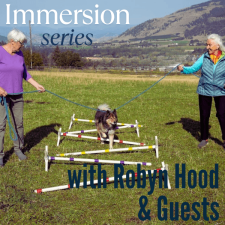
Interactive & Online Tellington TTouch® for Dogs
Immersion Series with Robyn Hood & Guests: May – Sept 2025
$200.00 – $999.00
Tellington TTouch for Dogs: 6-Month Immersion Course
May 10 – August 30, 2025 | Online + Live Zoom Sessions
Join Robyn Hood and guest Tellington TTouch instructors for a transformational 6-month online course that blends in-depth, self-paced learning with 30+ hours of live, small-group Zoom sessions. Learn gentle, effective, and empowering ways to improve your dog’s behavior, confidence, and well-being—from anywhere in the world.
Enrollment is open throughout the course period.
Live Session Dates:
Saturdays: May 10, May 24, June 7, July 19, August 2, August 16, August 30
Sundays: June 14, June 29, July 13
Time: 8:00–11:00 PT / 16:00–19:00 GMT via Zoom
All sessions recorded | Bonus 30-minute consult with Robyn Hood
Academy Credits: 36
Updated format replacing previous Level 1 & Level 2 courses
Payment plans available – 5 monthly payments of $200 or pay in full. Significant discount for practitioners & repeat students.
Full Details and RegistrationOur Method for > Other Animals > Success Stories
Building Trust
By Missy Parker, Veterinary Nurse
"One of the most beneficial things I've seen in a long time for building trust and calming is the Tellington "TTouch" therapy system, developed by Linda Tellington-Jones.
"In my capacity as a Registered Veterinary Nurse, I have used TTouch to prevent dogs from going into shock (yes, it really does work!) until the vet could get there to help the dog. In my capacity as an obedience instructor, I have used portions of it in my greeting (and subsequent handling) behaviors with scared dogs (as well as with aggressive ones) to build up their trust in me while calming them in a class situation. I have also used portions of it when I'm wearing my "mom" and "wife" hats to "create an atmosphere more conducive to cooperation."
"I've never told the humans I've used it on that it was developed for animals.However, Baylor Hospital of Dallas, Texas (which is a teaching hospital) is now using it on their human patients - and telling them it was developed for animals - so maybe it's time for me to come out of the closet!
"I've seen TTouch work wonders in every case in which it has been used properly. Four particular cases come to mind. The first is a Shiba Inu who would "short-circuit" in my obedience classes when the stimulation level got at all elevated. With just five to ten minutes of TTouch from his owner before each class, the dog did so much better!
"The second: my client, a very competent middle-aged woman, had never owned a dog before she adopted a female GSD stray. My best guess as to this dog's story is that she was either from Schutzhund lines or a washout from a police dog program, then neglected severely for quite a while afterward. She had heartworms and callouses on every pressure point from, I believe, lying in a concrete-bottom kennel.
"Heidi (the dog) was the most accomplished kennel escape artist I've ever dealt with ... she escaped mine five different ways before I figured out how to keep her in - she had both removed the gate from its hinges and bitten the gate lock in half. I just love this dog because I have learned so much from her! When she first started coming to my classes, Heidi would roar in dragging Cathy (the owner) as though she were an embarrassing ball-and-chain to be completely ignored. Now, after a few months of class, TTouch, and good management, Cathy has a much nicer dog - who adores her. Like many other dogs I've seen on TTouch regularly, Heidi can be gently reversed when she goes into overdrive, and quickly, by the application of as little as two minutes of TTouch touches.
"The third: Silver is a toy poodle who was genetically predetermined to be a yappy, snappy, shaky mess. She is now a fabulous therapy dog, solid at CD-level obedience, a joy to her owner and to everyone else with whom she comes in contact. TTouch is used in Silver's daily life in general and, specifically, before and after therapy sessions with challenging clients. By the will of her owner, with a little help from me, this dog has gone from "sow's ear to silk purse." By the way, Silver has only 20% vision in one eye and about 40% in the other; she will eventually go totally blind.
"The fourth case is my husband, who has back trouble - the pain sometimes makes him very "crabby." TTouch helps him feel better and consequently elevates his mood, which has the effect of making everyone in my house feel better!
"In classes, I begin with the Tarantula/Plow techniques. Even “extreme” dogs seem to enjoy it so much and/or are so curious about what I'm doing that they momentarily interrupt their agenda to ... eat the people, eat the other dogs, die of fright, whatever. Then, when I have their interested attention, I move to Noah's March. If all's still well, I use the Lying Leopard. All of this is done while toning.
"Years ago, when I was in hard labor, a female Labor Attendant did it on me - and it worked then, too - although she had no idea that what she was doing would years later be called the TTouch. Her technique was a super light touch, Clouded Leopard all over my straining belly while she softly sang “Rock of Ages” to me! It was incredibly helpful at a very stressful and painful time.
"The effect of regular TTouch use seems to be cumulative if these techniques are used with a subject regularly, his or her body’s autonomic responses seem to take over faster and faster each subsequent time.
"So, from my experience, I heartily recommend TTouch as a great addition to your instructor’s toolbox...and thanks to Terry Ryan for the term!
"Next time you have a bad headache, try it on yourself - it works that way too!"
- Missy Parker thunderridgeinc@juno.com
Missy continued:
"Tellington TTouch was born out of Linda's extraordinary lifetime of work with horses, and has now been adapted to many species other than equine, including dogs, cats, hamsters, and many exotic animals. Linda's four years of study with Dr. Moshe Feldenkrais, originator of the Feldenkrais method for horses, led her to the development of TTouch.
"Although TTouch is not technically a type of massage therapy, that would start to describe it. Actually, massage is done with the intent of affecting the muscular system - the intent of TTouch is the reorganizing of the nervous system and activating the function of the cells. I can describe it best by saying that it is a way of laying your fingers gently on the skin and moving them, as well as the skin they are touching, in a circular fashion, making repeating one-and-a-quarter circles clockwise. During this touch, the practitioner breathes rhythmically - in for the first half of the slow circle and out for the second half.
"According to Linda Tellington-Jones, TTouch is so simple to learn that a person having had less than one hour of instruction might make major changes in the behavior and personality of animals, and might considerably speed up the healing of wounds, injury or stiffness.
"Anna Wise, of the Evolving Institute of Boulder, Colorado, did a biofeedback study of TTouch practitioners which showed that both the brain waves of the practitioner, as well as those of the patient, were dramatically affected during the sessions. The brain waves registered what is known as "an awakened state" typical of healers, swamis, advanced meditators, and yogis as measured in a study by Maxwell Cate at the Institute for Psychobiological Research in London, England.
"There are several variations of TTouch hand positions; the amount of pressure used in the touch itself and where the touch is applied on the animal's body can vary, too. For instance, to prevent shock in injured animals of many species, as well as to calm the thunderstorm-phobic dog, T-Touch is applied to the ears.
"To make it easier to remember many of the hand/finger positions, they have been assigned the names of various animals: "Tarantula,” "Clouded Leopard,” "Flick of the Bear's Paw." With the TTouch, a practitioner may use "toning," a type of soothing vocalization.
"The Tellington TTouch Guidebook for Dogs describes the intended results of TTouch: to activate neural pathways to the brain, increasing an animal's self image and awareness, thereby improving its self-confidence and coordination. It adds: one need not know anatomy to be successful with this therapy, since using the TTouch anywhere on the body can improve health and awareness. Through the activation of its unused brain cells, an animal becomes more willing and able to learn. The TTouch develops a "cell-to-cell" between animal and human, a oneness which is a very special inter species, non-verbal communication."
Worldwide > Animal Ambassadors International
1985 Animal Ambassadors International in Gorky Park
TTEAM News International May, 1985 Vol 5 No 2 P. 13
I had so many highlights in this trip, I can’t say which is the highest, but the thrill of the self initiation of 150 children and adults into the Animal Ambassadors International® concept is impressed most deeply in my mind. On Sunday, April 14th, 1 gave a three hour presentation of my interspecies work to members, of all ages, of the Gorky Park Family Club. They had been well prepared for my visit by freelance journalist Andre Orlov. The month before my visit, Andre had presented the dolphin legend to the group and had them accompany the flute of Paul Winter and the howling wolves which Andre had from a personal interview with Paul in Moscow. The universe works in amazing ways. The same week that I had written my vision of the second phase of Animal Ambassadors International - that we humans should be ambassadors for the animal kingdom and speak for them - Andre had presented the same idea in a different way to this group. He told them that American Indians in the past had chosen various animals as protection for themselves. These were their totems. Andre suggested that now we become the totems for the animals. In junior high school Andre was an Indian as part of their school function. He had an American Indian name and his class had a private, locked room which was filled with Indian artifacts and officially recognized by the teachers. Only members of the Indian council could enter the room and the responsibility was passed along very seriously.
That custom still exists in his school today in the central part of the USSR and I intend to take some Indian artifacts back with me to send to the school. If any of you have any Indian books or other material you'd like to send with me to Moscow in July, it would make a wonderful connection.
In my presentation I led the group in doing the TTouch on each other. Since this was not a horse group, each person being worked on decided what kind of an animal he or she would be. I also shared the idea of Animal Ambassadors International and we all closed our eyes and did a dolphin breathing meditation together during which each person chose an animal that they would like to protect. We shared animals and one six-year old asked if I thought a type of minute snail was important enough and if so, how could he do the TTouch on it. I said small beings are as important as the large ones. You can touch these snails with your "mind."
I wore my Indian ceremonial dress and of course shared with them that I am adopted Cherokee Indian, having felt the spirit of an Indian in me all my life. Andre translated the messages from Orca whales which I received last year. Because he has written so much about my work in the Soviet media, he knows the whale messages almost as well as I do. There was an easy feeling of flow as though the translation was almost a non-verbal communication with the group.
I finished my presentation by reading an Indian 'give-away' poem. During the reading everyone closed their eyes and I had them visualize that they were American Indians sitting on the central plains 100 years ago - feeling the whisper of the wind stirring the grass and their hair - feeling the rhythmical breathing of Mother Earth under their haunches as they say upon her - feeling the stirrings of memory in their beings of that American Indian connection to the forefathers who came across the Bering Strait from Siberia many generations ago. Our connections were very powerful and Andre is translating the poem to Russian.
NOTE: TTEAM is an acronym of "Tellington TTouch Equine Awareness Method." Since this article was written, Linda decided to use a brand name for all the facets of the TTouch organization. Currently, that is Tellington TTouch® Training.


